
Climate change is reshaping temperature and humidity patterns, creating conditions that favor the growth of fungi from the genus Alternaria, particularly Alternaria alternata. These fungi are now spreading more widely across crops and regions, increasing the risk of contamination by Alternariol (AHO), especially during storage and transportation. Alternariol is a benzochromenone isocoumarin compound, and its production is intensified under environmental stress, such as fluctuations in water activity commonly caused by extreme weather. As a result, AOH is emerging as a significant risk to food and feed safety worldwide.
Once produced, AOH can persist or bind to sugars and sulphates, forming “masked mycotoxins” that escape detection but can revert to their toxic form during digestion. High concentrations have been found in barley and nuts. Due to its resistance to heat and processing, contamination can easily be transferred from raw crops to final food and feed products.
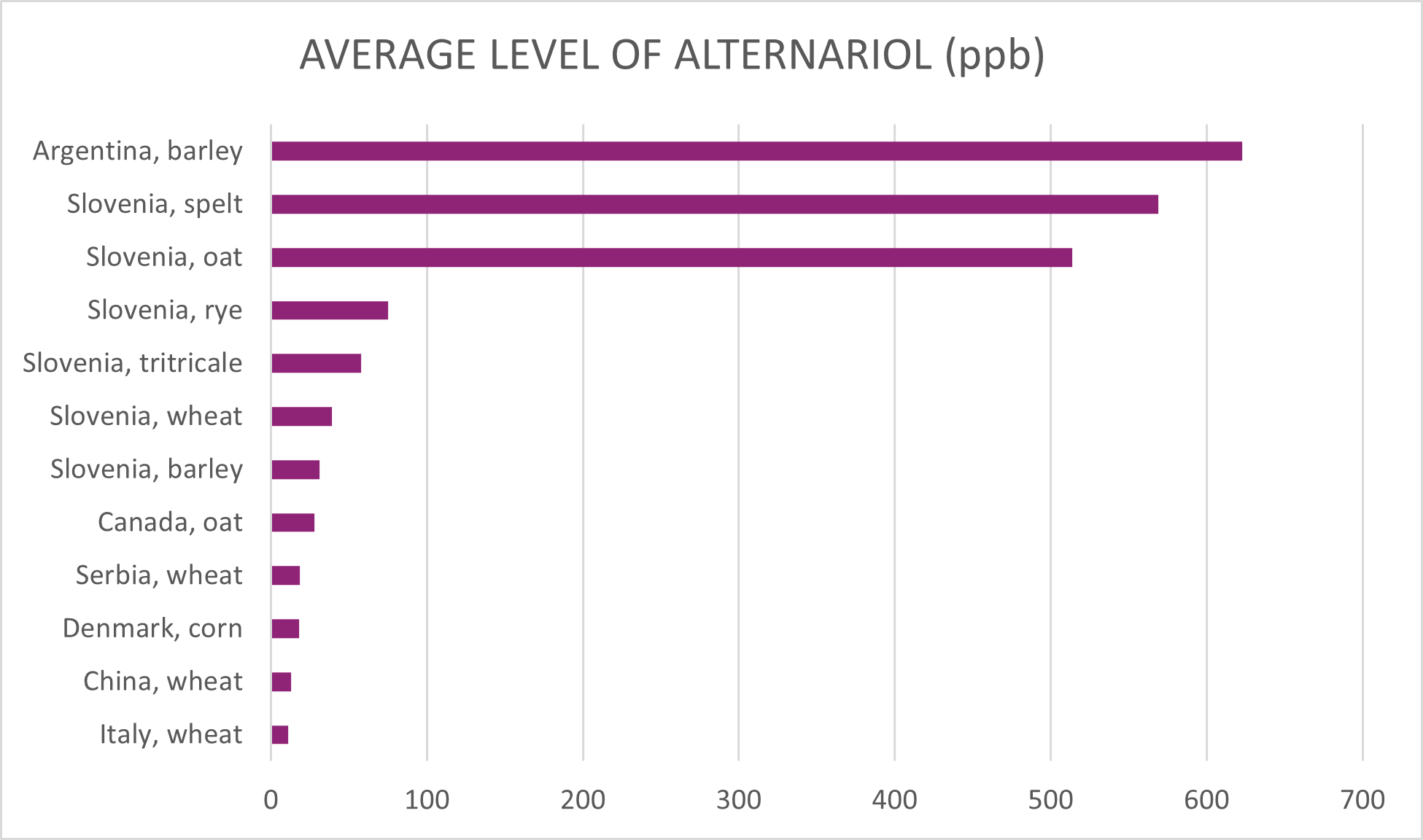
Alternariol is an “emerging mycotoxin”, and EFSA does not have any recommendations for contamination levels in cereals and feeds. The fact that it can develop in a wide range of temperatures (between 4 °C and 35 °C), makes that it can survive and continue to produce spores at low temperatures. In a review done in cereals, AOH highest average level was in barley samples from Argentina; and spelt and oat samples from Slovenia, as shown in figure 1.
In animals, AOH has multiple toxic effects. Studies in rats report oxidative stress, DNA damage and inflammation, especially in liver and intestinal tissues. It also mimics estrogen and interacts with androgen receptors, which can disrupt reproductive and endocrine functions. Although acute toxicity is low, chronic exposure to low doses through contaminated feed could affect animal health, productivity, and fertility.
Monitoring their presence in crops and feed ingredients, developing predictive models based on meteorological data, and promoting broad-spectrum mycotoxin binders are key steps in the risk management strategy.
Reference: Saleh, I; Zeidan, R and Abu-Dieyeh, M. 2024. The characteristics, occurrence, and toxicological effects of alternariol: a mycotoxin. Archives of Toxicology 98: 1659-1683. https://doi.org/10.1007/s00204-024-03743-0 https://doi.org/10.1007/s00204-024-03743-0