

In pigs and broiler chickens, the effects of deoxynivalenol (DON) on feed intake, intestinal integrity, and feed efficiency are now well documented. In laying hens, however, available data remain more limited. A study published in 2026 in Scientific Reports provides particularly interesting insights: beyond the expected effects on production performance, DON may also directly affect reproductive health.
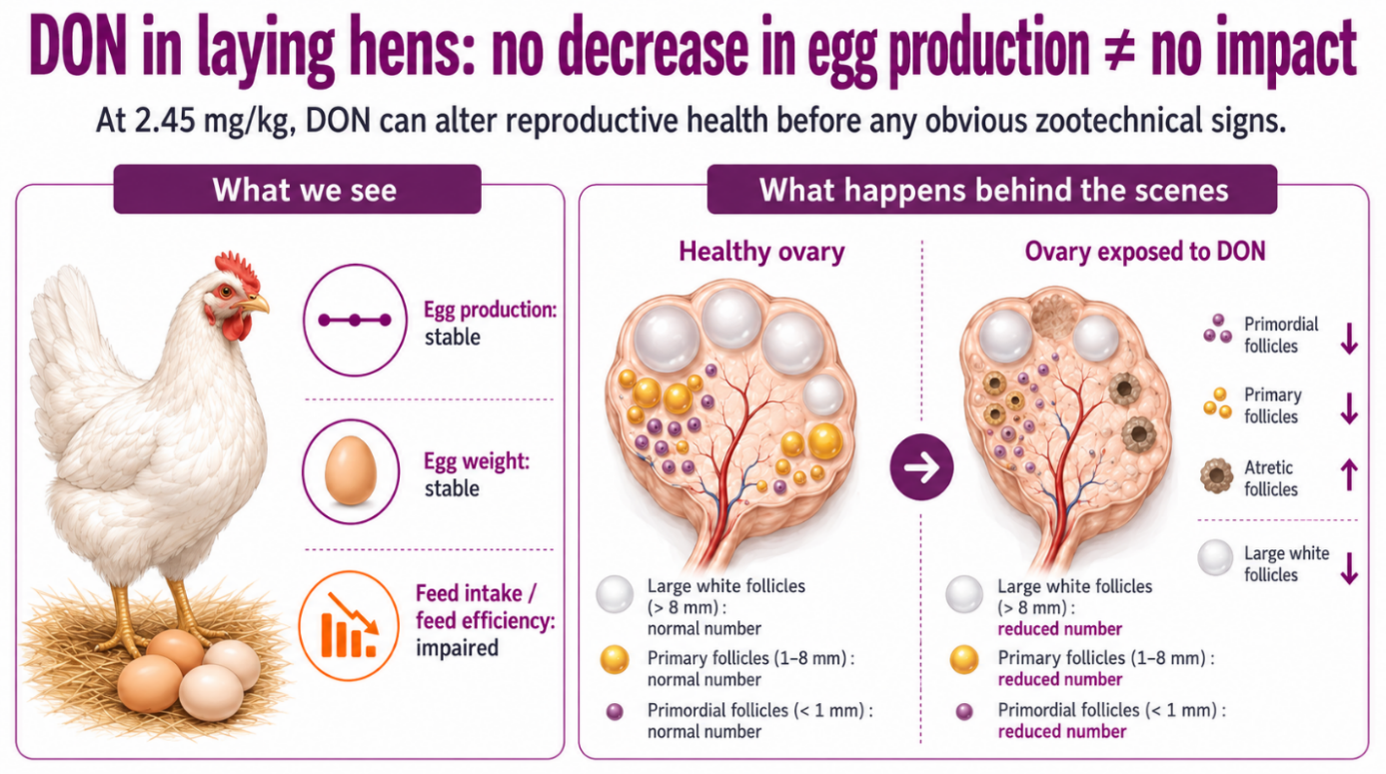
Six hundred 56-week-old Dekalb White laying hens were fed for 16 weeks either a control diet or a naturally contaminated diet containing 2.45 mg/kg DON. After just 8 weeks of exposure, feed efficiency was impaired: hens consumed more feed without any increase in laying rate, egg weight, or egg mass. This finding is consistent with the effects of DON already widely reported in other species.
However, the most novel finding concerns the ovary. After only 8 weeks, the proportion of normal primordial and primary follicles was significantly reduced. After 16 weeks, this alteration persisted and was accompanied by a decrease in the number of large white follicles, along with increased signs of follicular degeneration.
These findings are particularly important because primordial follicles constitute a non-renewable ovarian reserve. Yet, laying rate remained comparable between groups. In other words, the absence of an immediate decline in production does not mean the absence of a biological impact. These follicular alterations could lead to premature aging of the reproductive system.
The study also highlights alterations in intestinal health and calcium-phosphorus metabolism, confirming that the effects of DON in laying hens extend well beyond visible performance parameters.
These findings suggest that the impact of DON on reproductive function in laying hens has probably been underestimated to date, with potential consequences for long-term laying persistency.
Note: the experimental diet was naturally contaminated with multiple mycotoxins, with DON being the predominant mycotoxin. The results therefore reflect conditions closer to those encountered in the field rather than exposure to pure DON.
Reference : Basili E, Star L, Beleva G, Molist F, Milanova A, Santos RR. Short-term dietary deoxynivalenol exposure negatively affects performance, intestinal and reproductive functions in laying hens. Sci Rep. 2026 Apr 11;16(1):16920. doi: 10.1038/s41598-026-46100-0. PMID: 41965801; PMCID: PMC13230629.